Identity theft protection and dark web monitoring are not the same feature. Dark web monitoring scans breach databases and alerts you when your credentials appear. Full identity theft protection adds credit bureau monitoring, Social Security number (SSN) tracking, identity theft insurance up to $3M, and identity restoration support — available only at the top tier of each antivirus plan line reviewed here.
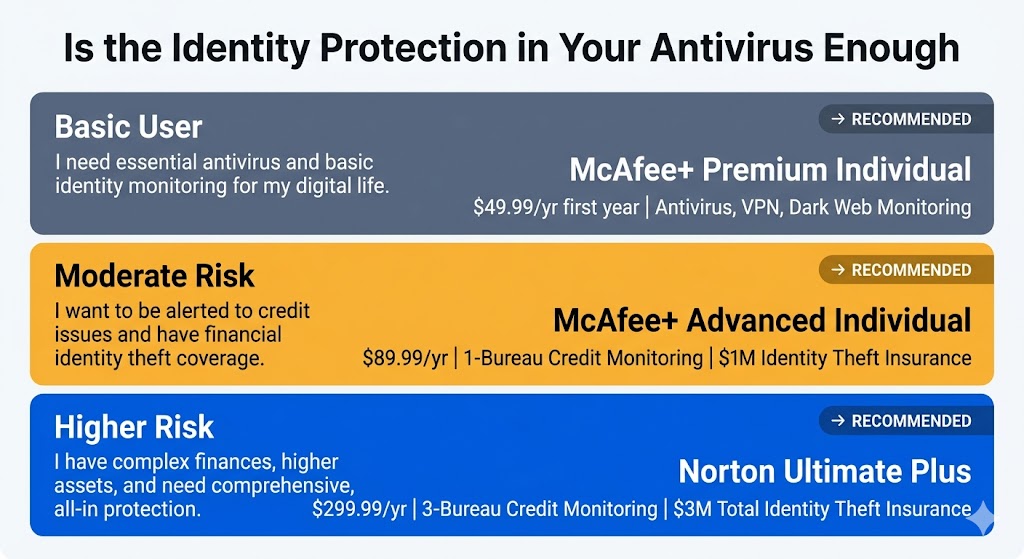
Fraud cost American consumers $12.5 billion in 2024 — a 25% increase over 2023 — and the FTC recorded over 1.1 million identity theft reports in the same year (Source: FTC Consumer Sentinel Network, March 2025). Your antivirus plan may already include some level of monitoring. The question is whether what is included at your current tier is enough — or whether a higher tier or standalone service better fits your exposure.
This article breaks down exactly how each feature works, which antivirus plan tiers include it, what the monitoring actually scans, and how to respond when an alert fires.
Table of Contents
What Dark Web Monitoring Actually Does
Dark web monitoring scans underground databases, hacker forums, and breach marketplaces for your personal identifiers — and alerts you when a match is found. It does not prevent the breach. It tells you one has already occurred, so you can take action fast.
Here is what a dark web scan typically checks for:
- Email addresses and associated passwords
- Social Security numbers
- Credit card and bank account numbers
- Phone numbers and home addresses
- Passport and driver’s license numbers (top-tier plans)
The dark web is a network of encrypted, non-indexed sites used to buy and sell stolen data. When a company is breached, your credentials often appear in these markets within hours. A monitoring tool constantly compares your registered information against known breach databases and sends you an alert when your data surfaces.
Dark web monitoring scans underground databases and breach markets for your personal identifiers and alerts you when a match is found. A dark web alert means your data is already exposed — the monitoring service cannot prevent the original breach.
The bigger question is whether dark web monitoring alone constitutes full identity protection — or whether the term covers something significantly broader.
Dark Web Monitoring vs. Identity Theft Protection: Not the Same Thing
Dark web monitoring is one component inside a full identity theft protection suite — not the whole package. Full identity theft protection adds credit bureau monitoring, SSN tracking, identity theft insurance up to $3M, and identity restoration support. The two are complementary, not interchangeable.
Credit monitoring watches your credit file at Experian, Equifax, and TransUnion for new accounts, inquiries, or changes. Dark web monitoring scans underground markets for stolen credentials. They detect different threats — you need both for complete coverage.
The comparison below shows which specific protection elements each layer includes and which it leaves out:
| Feature | Dark Web Monitoring | Full Identity Theft Protection |
|---|---|---|
| Scans breach databases | ✓ | ✓ |
| SSN / email / password alerts | ✓ | ✓ |
| Credit bureau monitoring | ✗ | ✓ (1–3 bureaus by tier) |
| Identity theft insurance | ✗ | ✓ ($1M–$3M by tier) |
| Identity restoration support | ✗ | ✓ |
| Stolen wallet assistance | ✗ | ✓ |
Dark web monitoring is one component of identity theft protection — full coverage also includes credit bureau monitoring at Experian, Equifax, and TransUnion, insurance up to $3M, and identity restoration support. Credit monitoring watches your credit file at the bureaus; dark web monitoring scans underground markets — they detect different threats and work best together for complete coverage.
The most common misconception is that these two terms are synonymous. An antivirus plan that advertises dark web monitoring may still leave you without credit bureau coverage or financial insurance. Always check the tier-level feature list before you subscribe.
Knowing which features each protection layer provides sets the foundation for evaluating which antivirus plan tier actually includes what you need.
Which Antivirus Plans Include Identity Theft Protection? (Brand-by-Brand Tier Matrix)
Every major antivirus brand includes dark web monitoring at mid-range tiers — but full identity theft protection with credit monitoring and insurance only appears at the top tiers of each product line. Here is exactly what each brand covers at its identity-capable plans, verified as of April 2026.
| Brand & Plan | Dark Web Monitoring | SSN Tracking | Credit Bureau Monitoring | Identity Insurance |
|---|---|---|---|---|
| Norton — LifeLock Select Plus | ✓ | ✓ | 1 Bureau | Up to $25,000 stolen funds |
| Norton — LifeLock Advantage | ✓ | ✓ | 1 Bureau | Up to $100,000 stolen funds / $1.2M total |
| Norton — LifeLock Ultimate Plus | ✓ | ✓ | 3 Bureaus | Up to $1M stolen funds / $3M total |
| McAfee+ Advanced Individual | ✓ | ✓ | ✓ | Up to $1M |
| McAfee+ Ultimate Individual | ✓ | ✓ | ✓ + 401(k) / investment monitoring | Up to $2M |
| Bitdefender Ultimate Security Plus Standard | ✓ | ✓ Smart SSN Tracker | 1 Bureau | Up to $1M |
| Bitdefender Ultimate Security Plus Extended | ✓ | ✓ Smart SSN Tracker | 3 Bureaus | Up to $1M + investment alerts + court records |
| ESET HOME Ultimate (min. 5 devices) | ✓ | ✓ | ✓ Credit report | Up to $1M |
| Webroot Premium | ✓ | Identity monitoring (1 person) | Financial + credit bureau | Up to $1M fraud reimbursement |
| Webroot Total Protection | ✓ | Identity monitoring (1 person) | Financial + credit bureau | Up to $1M fraud reimbursement |
Norton’s LifeLock Ultimate Plus tier delivers the highest insurance ceiling in this comparison — up to $1M in stolen funds reimbursement and $3M in total identity theft coverage, across unlimited devices.
McAfee+ Ultimate Individual is the only plan in this comparison with 401(k) and investment account monitoring alongside $2M identity theft coverage — the standout feature differentiating it from the Advanced tier.
McAfee+ Advanced Individual and Webroot Premium are the lowest tiers in this comparison that include $1M identity theft coverage and credit bureau monitoring. McAfee+ covers unlimited devices; Webroot covers five devices and one monitored individual.
Beyond which brands offer full identity protection at the top tier, it is worth understanding exactly what that monitoring scans — and where its coverage ends.
What Antivirus Identity Protection Actually Monitors — And What It Misses
Top-tier antivirus identity plans monitor every identifier listed in the dark web scan above — emails, passwords, SSNs, card and account numbers, phone numbers, addresses, and government ID numbers. The highest tiers extend monitoring beyond breach databases into public and financial records:
- Change-of-address records (Bitdefender Ultimate Security Plus Extended)
- Court records (Bitdefender Ultimate Security Plus Extended)
- Investment account activity (Bitdefender Ultimate Security Plus Extended, McAfee+ Ultimate Individual)
The critical limitation: dark web monitoring tools can only access indexed portions of the dark web. Large sections remain inaccessible to automated scanners — which means a clean dark web scan result does not confirm your data is unexposed.
Top-tier antivirus plans monitor Social Security numbers, email addresses, passwords, credit card numbers, bank account numbers, and phone numbers across dark web breach databases. A clean dark web scan result does not mean your data is safe — monitoring tools can only access indexed sources, and much of the dark web remains unscanned.
This is why the insurance and recovery components of a full identity protection plan matter as much as the monitoring itself. Understanding these coverage limits is the first step in assessing whether your current plan tier is adequate for your financial exposure — or whether a higher tier provides the additional safety net your situation requires.
Is the Identity Theft Protection in Your Antivirus Enough — or Do You Need More?
Whether your current plan tier is adequate depends primarily on your financial exposure — specifically whether you hold investment accounts, multiple credit lines, or have a history of prior identity theft. A mid-range plan with dark web monitoring and basic identity alerts is sufficient for most single-device users with limited financial accounts. Users with investment portfolios, multiple credit lines, or a repeat-breach history need 3-bureau credit monitoring and at least $1M in identity theft insurance, available only at the top tier of each brand reviewed here.
Identity Theft Protection for Families: What Changes
Family identity protection plans extend coverage to multiple adults and add parental controls — the insurance amounts and monitoring scope change at the household level.
Bitdefender Ultimate Security Plus Family covers 2 adults at $1M each — totaling $2M in identity theft insurance — across 25 devices. The $2M figure applies to the Family plan only; Individual plans cap at $1M per the same product line. McAfee+ Advanced Family adds parental controls to its full identity theft coverage suite — a feature absent from McAfee+ Advanced Individual plans.
Bitdefender Ultimate Security Plus Family covers two adults at $1M each, totaling $2M in household identity theft insurance — the $2M figure does not apply to any Individual plan.
Knowing what the feature covers — and for how many people — is one part of the picture. The other is knowing what to do when the monitoring fires an alert.
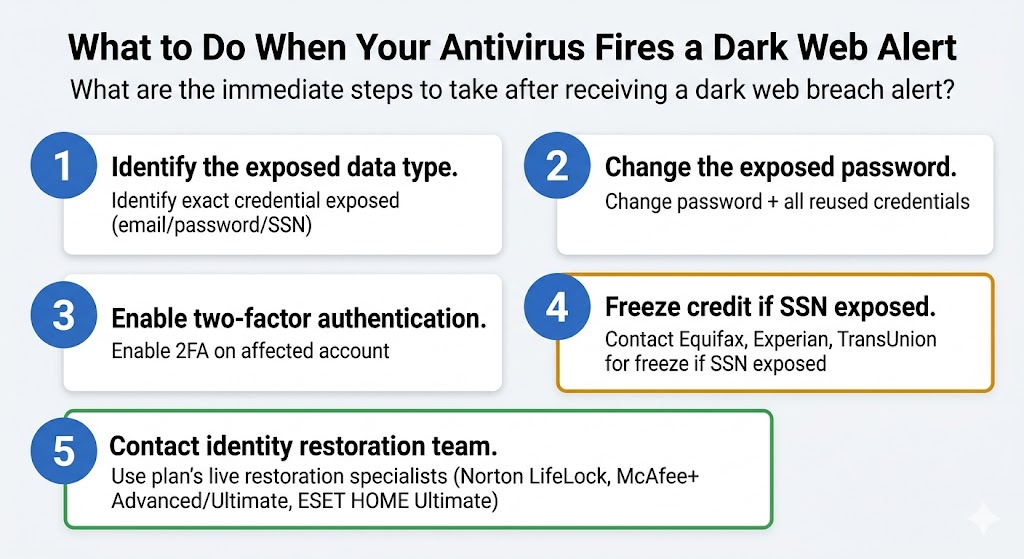
What to Do When Your Antivirus Fires a Dark Web Alert
When a dark web alert fires, act immediately — but verify the alert before panicking. Some antivirus notifications are genuine breach alerts; others are promotional notifications for plan upgrades. Here is how to respond correctly.
- Identify the exact data exposed. The alert should specify what was found — email address, password, SSN, or credit card number. An alert that names no specific data type may be a promotional notification rather than a confirmed breach match.
- Change the exposed password immediately. Change it on every site where you used the same password. Use a unique password for each account going forward.
- Enable two-factor authentication on the affected account. This eliminates the primary risk from a credential exposure even if the password was already harvested.
- Place a fraud alert or credit freeze if your SSN was exposed. Contact Equifax, Experian, and TransUnion directly. A credit freeze is free and the most effective tool against new account fraud.
- Contact your plan’s identity recovery team if you have full identity protection coverage. Norton LifeLock, McAfee+ Advanced and Ultimate, and ESET HOME Ultimate all include identity recovery support for confirmed identity theft events.
Changing the exposed password and enabling two-factor authentication on the affected account eliminates the primary risk from a dark web credential exposure. This combination makes a captured password worthless — attackers need both factors to access the account, so enabling two-factor authentication immediately after a breach alert is the single highest-leverage action available without a paid restoration plan.
The checklist below summarizes all five response steps for quick reference after an alert fires:
Does Antivirus Software Protect Against Identity Theft?
Antivirus software reduces your risk of identity theft — but it does not guarantee prevention. It works on two levels: blocking the malware and phishing attacks that steal your credentials in the first place, and alerting you after a breach has already exposed your data elsewhere.
Antivirus software blocks malware that steals credentials before theft occurs; dark web monitoring detects exposure after a breach — both layers are needed for full identity defense. The strongest protection combines top-rated antivirus — Norton 360, Bitdefender Total Security, and McAfee Total Protection each earned 18/18 in AV-TEST’s Home Windows evaluation (February 2026) — with active identity monitoring, credit bureau access, and strong unique passwords on every account.
No single tool eliminates identity theft risk entirely. The goal is to detect exposure faster than criminals can act on it — and have the insurance coverage to recover when they do. For a fuller picture of how antivirus protection works against the threats that lead to credential exposure, see our guides on how antivirus software works and protecting your online privacy.
Who Should Not Rely on Antivirus Identity Protection Alone?
Bundled antivirus identity protection has three structural coverage gaps that no current plan fully addresses regardless of tier:
- Investment portfolio and retirement account surveillance. McAfee+ Ultimate Individual’s 401(k) transaction monitoring is the only bundled antivirus feature that addresses investment accounts. Comprehensive surveillance of brokerage accounts, IRAs, and real estate holdings sits outside what any antivirus identity plan is built to cover.
- Business identity theft for self-employed users and sole proprietors. Consumer antivirus plans monitor personal identifiers — SSNs, personal email addresses, consumer credit accounts. Business entity identifiers (EINs, business credit accounts, professional license records) are not within the monitoring scope of any plan reviewed here.
- Accelerated re-exposure support for prior identity theft victims. Users who have experienced a prior identity theft incident face a materially different risk profile. The rapid-response restoration support and credit lock capabilities at the top tier of Norton and McAfee+ address this — but no bundled plan provides the proactive identity lock access that standalone identity protection services offer as a baseline feature.
These gaps reflect what the technology was designed to monitor, not implementation differences between brands. LifeLock standalone plans — Core, Advanced, and Total — provide identity-only coverage without requiring a device security subscription, and are the appropriate choice when device protection is handled separately. For a complete feature breakdown of each brand’s identity protection tier, see the Norton 360 Review, McAfee+ Review, and Bitdefender Review.
The Bottom Line on Identity Theft Protection and Dark Web Monitoring
Dark web monitoring alerts you after your data is exposed — full identity theft protection covers what happens next, and the two are not interchangeable. Every major antivirus brand includes dark web monitoring at mid-range tiers, but credit bureau monitoring, SSN tracking, and identity theft insurance only unlock at the top tiers of each product line.
For most users, McAfee+ Advanced Individual offers the clearest entry point to full identity protection — $1M coverage, credit monitoring, and automated personal info removal across unlimited devices. Step up to McAfee+ Ultimate Individual if you hold investment or retirement accounts, gaining $2M coverage and 401(k) monitoring. For the highest insurance ceiling, Norton 360 with LifeLock Ultimate Plus covers up to $3M in total identity theft losses — the strongest financial backstop in this comparison.
Entry-level plans with dark web monitoring only leave you without credit bureau access and without insurance. The difference between an entry-level plan and a top-tier identity plan is not just features — it is the financial safety net that matters most when a breach turns into actual theft. For a decision framework matching your risk profile to the right coverage tier, see our guide on how to choose antivirus software. Review current first-year pricing and available discounts on each brand’s best antivirus deals page before you subscribe, and see our best antivirus software guide for how each brand ranks across all protection features.